About
Every wisdom tradition has answered the deepest questions the same way — not with argument, but with symbol.
The symbols we place in our environment are not decoration. They are foundation stones for your soulscape.
This is not a metaphor. It is what the pre-modern world understood with a clarity we have largely lost. Every culture that built temples, carved altars, and filled their spaces with deliberate symbolic forms knew that the deeper layers of the mind are not reached by argument. They are reached by symbol — by the repeated presence of forms that carry meaning below the threshold of conscious thought.
When that technology was dismissed as superstition, we did not stop forming our inner world. We simply stopped doing it deliberately. Temple Artisan works to change that — with every symbol carved from a decade of study in a living wisdom tradition, and with hands trained to serve that understanding.
The Artisan
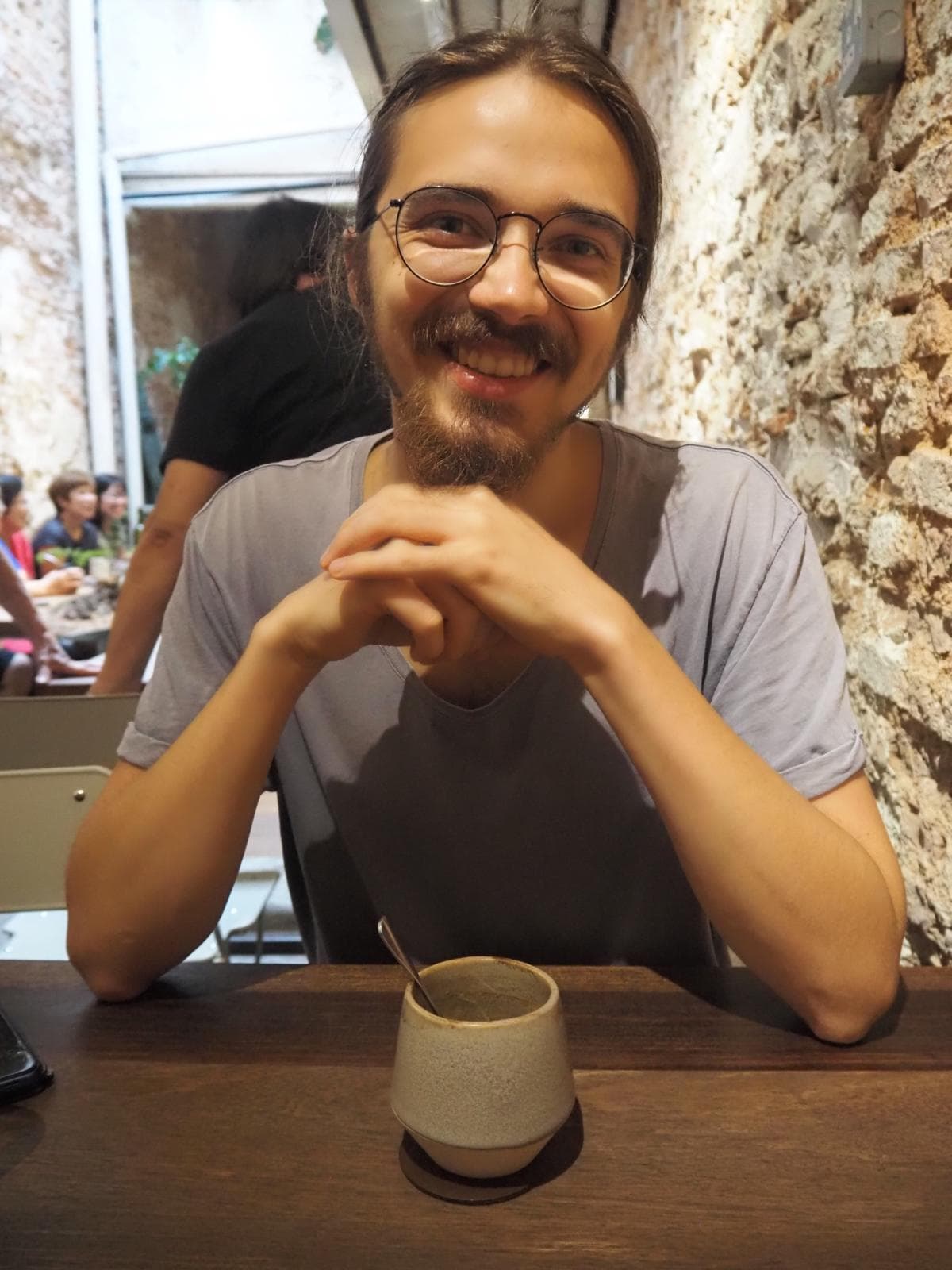
I am an artisan.
My primary foundation is a living Kaula yoga lineage transmitted by Bhagavan Shri Shanmukha Anantha Nathan — a line of knowledge passed from teacher to student, intact across centuries. Through this lineage I learned not only how the pre-modern world understood reality, but how its knowledge worked: what myth is actually doing in the mind, what ritual accomplishes that instruction cannot, why a symbolic object needs to be rooted in a deeper reality — and why it does not work without it.
Alongside this I studied classical Greek and Latin — to read primary sources in the language they were written in. I have trained in icon painting at Valamo Monastery in Finland, where I encountered a tradition in which the act of making is itself a contemplative practice: the hand is not expressing the individual but transmitting something that transcends it. I trained as a woodworker at the Ikaalinen Crafts and Design Institute, and I am currently completing further training as a metalsmith. Bronze casting is the goal — bronze has its own deep history in the sacred objects of every ancient culture, and it will extend what wood has begun.
The Road
I was four years old when they first appeared — alone in a yard, asking what this world fundamentally was. The first answer that came was mythological: the world was a comic book drawn by giants. It was the only mythological language available to a child who could not yet read, but the instinct behind it was sound. The modern world offered a different answer, and for a long time that early mythological attempt went quiet. The question never left.
In my youth, the search began through Eastern philosophy — the recognition that the world can be experienced differently from within. This led, gradually, to a living tradition, and through it to the lineage that became my foundation. There I learned that understanding alone is not enough. The compass toward a coherent life is found only in practice, not in theory.
For years the intellectual temptation ran strong. I studied classical philology at university, reading ancient philosophers in the languages they wrote in. My teacher Bhagavan saw what was happening and named it directly: stop over-intellectualising. What the lineage demanded was not more reading but mastering the practice. That correction was the one that mattered.
The hands had always been part of this — trained as a woodworker, I was drawn early to the patience that good craft demands: staying with the material until it is genuinely right. At Valamo I painted icons and understood for the first time that making can be a contemplative practice: the hand trained to transmit rather than express begins to move differently. In 2021 I built my first carved symbolic work for Sipoonjoki Traditional Sauna and understood something the theory alone could not have taught. The carved symbol is the understanding made material — not an illustration of an idea, but its enactment.
In 2025 my first child was born. The question of what to build a life on — and what to hand forward — acquired a different kind of weight.
The Work
The altar is the first fully realised form of this work. Its symbols are not drawn from a single cultural tradition. They come from the shared symbolic vocabulary that pre-modern cultures across the world developed from direct perceptual experience — a language with its own dialects, but a core consistent enough that someone who understands one tradition can navigate others. The swan as the soul's kinship with the infinite. The serpent as the energy underlying all manifestation. The world tree as the axis on which earth and heaven meet.
These symbols were not invented. They were recognised — in the structure of perception itself.
An altar made this way is not an aesthetic object. It is a point of orientation. A concentrated form of symbolic language, placed where it can do what argument cannot.